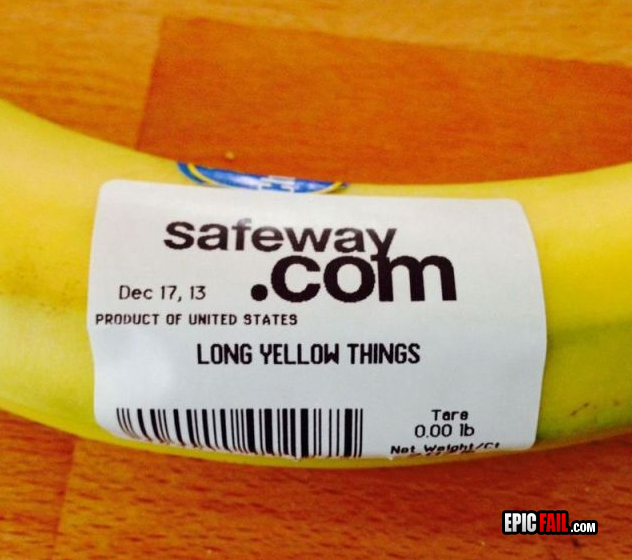
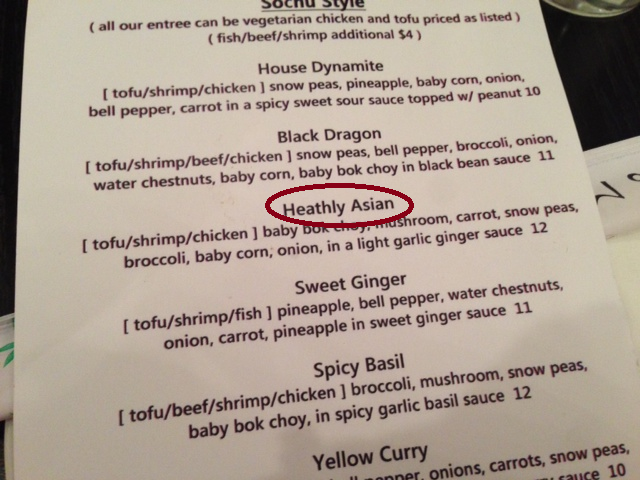
This one is from a friend. I didn’t know mobile homes came with this option.



Copyright: 3m3 / 123RF Stock Photo
Here are just a couple of quickies that don’t really warrant an entire blog post, but where readers have requested clarification.
1. Kitty corner or catty corner? According to Merriam-Webster Online, kitty-corner is used to describe two things that are located across from each other on opposite corners. Variants of kitty-corner are both catercorner and catty-corner. Which word you use could be determined by where you live. Those in the northeast part of the country use kitty-corner most often and those in the southeast part of the country use catty-corner. This website has a map based on a dialect survey that is interesting for this issue – http://www4.uwm.edu/FLL/linguistics/dialect/staticmaps/q_76.html. Basically, all three forms are correct, but catercorner and catty-corner are derivatives of the more popular katty-corner.
2. Onto or on to. Onto is a preposition describing the direction of something moving toward a surface. A trick that you can use is to check to see if on can replace onto.
She climbed onto her car.
In this sentence, onto is correct because “She climbed on her car” makes sense. On the other hand, if you left someone something in your will, you would not say “I passed my grandfather’s pocket watch on him,” so that sentence should be:
I passed my grandfather’s pocket watch on to him.
Let me know if you have something you struggle with. Chances are that it isn’t just you and others can benefit from a blog post about that very topic. Comment below or email proofthatblog@gmail.com.
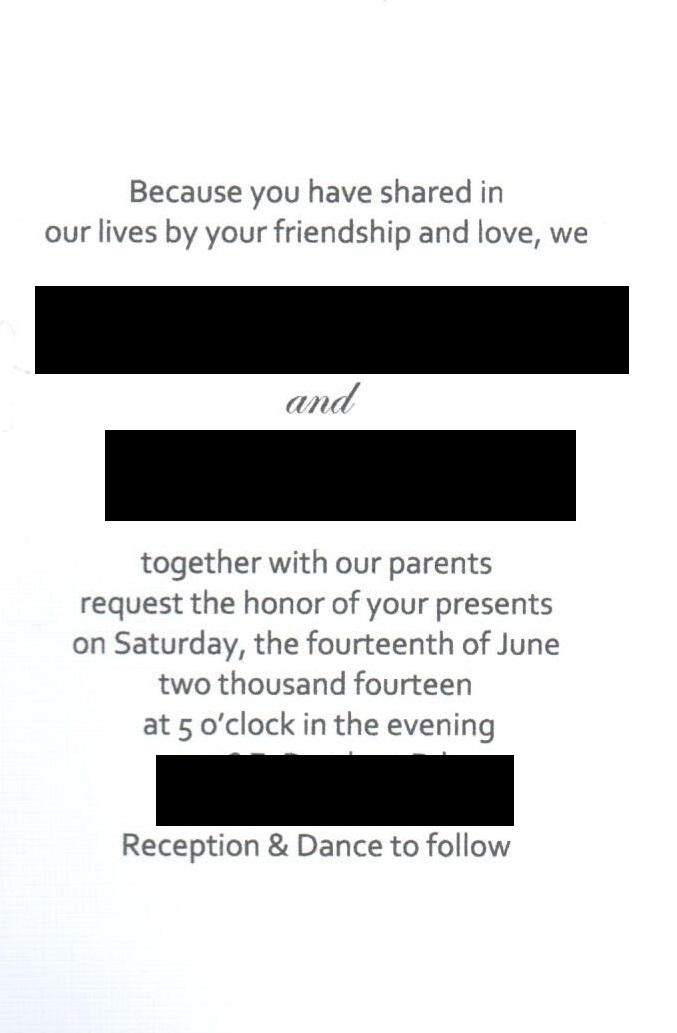
I found this one on Twitter. If you don’t think you have a good grasp of grammar and homophones, please take someone with you (or at least let them look at the language before you have invitations printed). This is just embarrassing. At least it is if it was truly an error and the bride and groom aren’t just greedy.
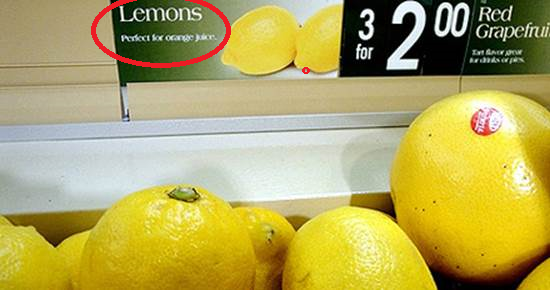
A friend sent this one to me. I don’t know about you, but I haven’t ever put lemons in my orange juice. Maybe it’s a California thing.
I saw this one on a local news channel on a story about how our storms this weekend affected a home and garden show and I’m shocked that this sign got this far with the glaring error. I just hope it’s not an error that shows up in all their marketing materials. Unbelievable!

 I learned something interesting this week. As much as you think you know about something, every once in a while it is good to check your resources. While I covered this topic according to the Gregg Reference Manual in a post entitled Things Are Coming to a Head(ing) about exceptions to the “capitalize everything except articles, conjunctions, and prepositions shorter than four letters” rule, a recent search through The Bluebook showed me that that rule was not correct for headings in a legal document done in “Bluebook style.” According to Section 8 of The Bluebook, in headings and titles, the first word in the heading or title and the word immediately following a colon in a heading or title should be capitalized. However, do not capitalize articles, conjunctions, and prepositions of four or fewer letters unless they fit the criteria in the immediately preceding sentence (they are the first word of the title or immediately follow a colon).
The Bluebook does, however, refer you to The Chicago Manual of Style or the Government Printing Office Style Manual if there are questions not answered in The Bluebook about specific capitalization issues. Here are the rules on capitalization according to The Bluebook:
I guess I’ll have to read through The Bluebook again just for good measure to see what other “rules” need to be adjusted.
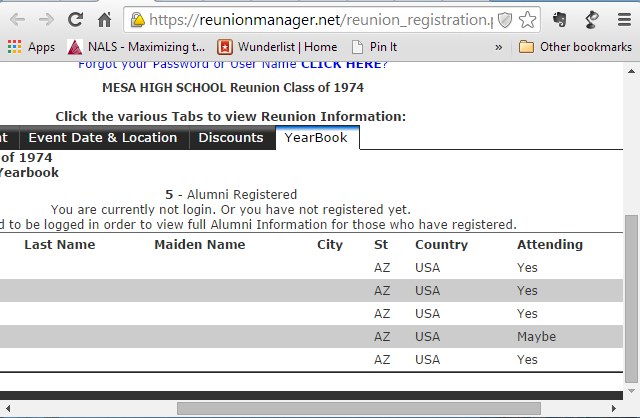
My class reunion is next month, and while I was signing up for it, I came upon this page that I don’t even understand. Someone should have read this language and they would have realized things were wrong and missing.
 I had a request to write about affect and effect. Since I’ve had trouble with those words in the past myself, I completely understand how confusing they are! Dictonary.com defines affect as a verb (used with an object) meaning:
“Cold weather affected the crops.“
“The music affected him deeply.“
“to affect knowledge of the situation.“
“to affect a Southern accent.”
It is also defined as a noun meaning feeling or emotion.
Effect is defined as a noun:
“Exposure to the sun had the effect of toughening his skin.“
“His protest had no effect.“
And as a verb (used with object):
“The new machines finally effected the transition to computerized accounting last spring.“
So what does that mean really? Affect is usually used as a verb to mean to influence or change. Effect is either used as a verb meaning to bring about or as a noun meaning the result or impression. Which would you choose when you hear “The wine didn’t have quite the affect/effect she was hoping for”? Some of these are so close that either could be correct, so you need to dig just a little bit deeper. First, you need to decide if it is a verb (an action word) or a noun (the name of a person, place, object, idea, quality, or activity). “The wine didn’t have quite the [action] she was hoping for.” So the verb definitions are affect to influence or change and effect to bring about. Would you say “The wine didn’t have quite the influence or change she was hoping for” or “The wine didn’t have quite the bring about she was hoping for.” The correct word is affect.
“The new paralegal was affecting/effecting the morale in the office.” The paralegal was creating an action on the morale in the office so was the new paralegal influencing or changing (affecting) the morale or was he bringing about (effecting) the morale? It should be affecting.
“The uncertainty in the legal market affected/effected attendance at the conference.” The uncertainty influenced or changed the attendance or the uncertainty brought about the attendance? Here, it would be affected.
One more for good measure: “The ruling in this case will affect/effect future door-to-door sales.” Will the ruling influence or change sales or will the ruling bring about sales? This should be affect.
We’ve done some practice with affect/effect as verbs, let’s try one as a noun. “The affect/effect of the storm damage won’t be known for some time.” Is it the feeling or emotion of the storm damage that won’t be known or is it the result of the storm damage that won’t be known? It should be effect.
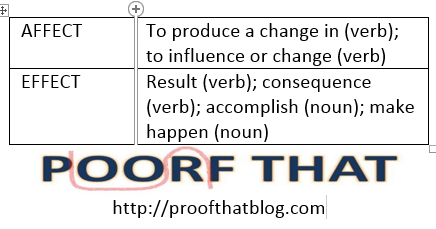
These two words are very confusing. If it will help, copy the chart below and keep it at your desk for a quick reference:
 Follow