
You know we couldn’t get through this week without some kind of Valentine fail. This is one I found on the Internet. Sometimes pretty just isn’t enough..


You know we couldn’t get through this week without some kind of Valentine fail. This is one I found on the Internet. Sometimes pretty just isn’t enough..
As I’ve mentioned before, when you are quoting material, it has to be an exact quotation. So what happens when the author of that exact quotation has made an error? That’s where our Latin friend sic comes in. The word sic means “thus” or “in such a manner.” It means that the writer knows that the quoted material is wrong, but it is the original author’s mistake, not the current writer’s mistake. Just be careful about using sic where the word or phrase you think is wrong may just be an archaic spelling or usage–but not necessarily grammatically incorrect.
According to Bryan A. Garner in A Dictionary of Modern Legal Usage ((2nd edition). Oxford University Press US, 2001), in state-court opinions before 1944, sic appeared 1,239 times in the Westlaw database; in those from 1945 to 1990, it appeared 69,168 times. I can only imagine that its usage has increased more dramatically still in the last 25 years.
Using sic should not be thrown around carelessly or to attempt to show an air of superiority. Such usage is called “benighted use” and is thought to have accounted for a large part of the increase in the use of sic.
As for formatting, modern American usage and The Gregg Reference Manual have the word sic in italics and surrounded by brackets–[sic]. Some authorities say that it is now such common usage that it is not formatted in italics. The Bluebook shows sic not italicized but enclosed in brackets–[sic]. Since The Bluebook is the standard for legal citation, it would appear that when you use it in legal documents, sic does not need to be italicized. The Bluebook also says that “[sic]” should follow “significant mistakes” in original language, so put “[sic]” right after the word with the issue and not at the end of the sentence or passage. The reader needs to know that you know it is an error at the point it is an error and not lines or words later.
Use [sic] where necessary and when necessary. It does have an important use and is a useful tool in our work, just do not overuse it to prove you’re smarter than anyone else. Nobody likes a showoff!
This is from a reader who has a real eagle eye for Grammar Giggles and sends them to me regularly. It is a great example of not relying on spell check (and also a reminder to change the setting in Word to not ignore words in all caps–although that wouldn’t have helped in this case).

I came across this on a webpage while I was looking for potential speakers for a conference we’re working on.
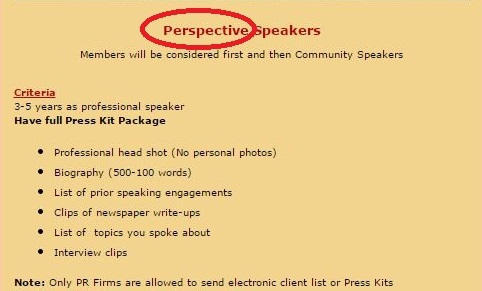
Here’s the problem (according to the Gregg Reference Manual):
perspective – means to view in correct proportion
prospective – means anticipated
So I’m thinking what they are really looking for are anticipated speakers, not speakers they will view in the correct proportion (wrong on so many levels). I have emailed them about this error so they can fix it. But using it as a teaching moment, I include it here, leaving off the identifying information. My goal is never to embarrass a person or company who has an error in a public place, but to use it to teach you all what is really correct.
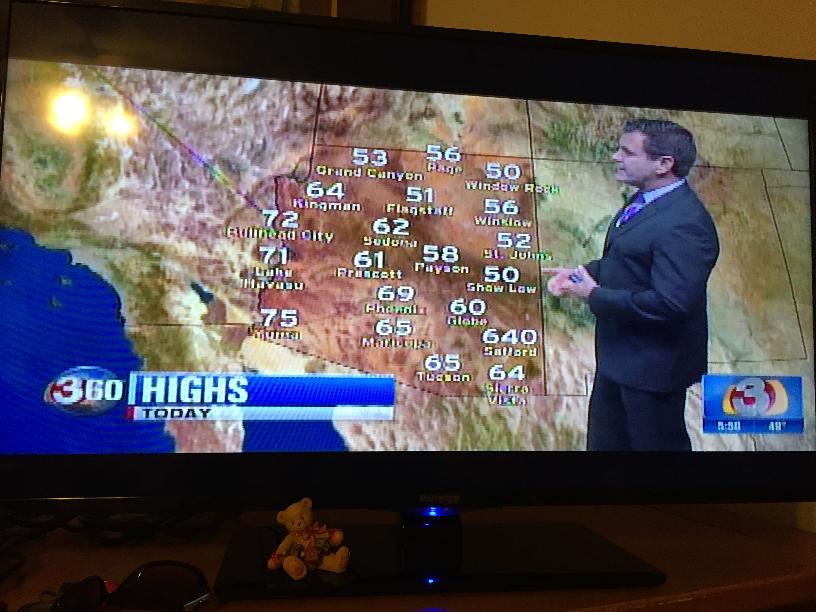
A friend captured this little jewel on our local news last month. With all the weird weather across the country, I thought this was timely. Check out the weather in Safford. Arizona can be hot in the summer, but not usually in December and 128 is our all-time record high. It looks like someone’s typing fingers got a little carried away.
 I like to check out the new words added to dictionaries each year. So now (drumroll please) the 2014 Oxford Dictionaries Word of the Year . . . vape. Vape is an abbreviation of vapour or vaporize and is defined as “to inhale and exhale the vapour produced by an electronic cigarette or similar device.” So because it is not “smoking” because it is just vapor, it is “vaping.” Interesting. What were some of the entries on the shortlist you might ask?
So there are your new words for 2014. Learn them, use them, and make them yours.
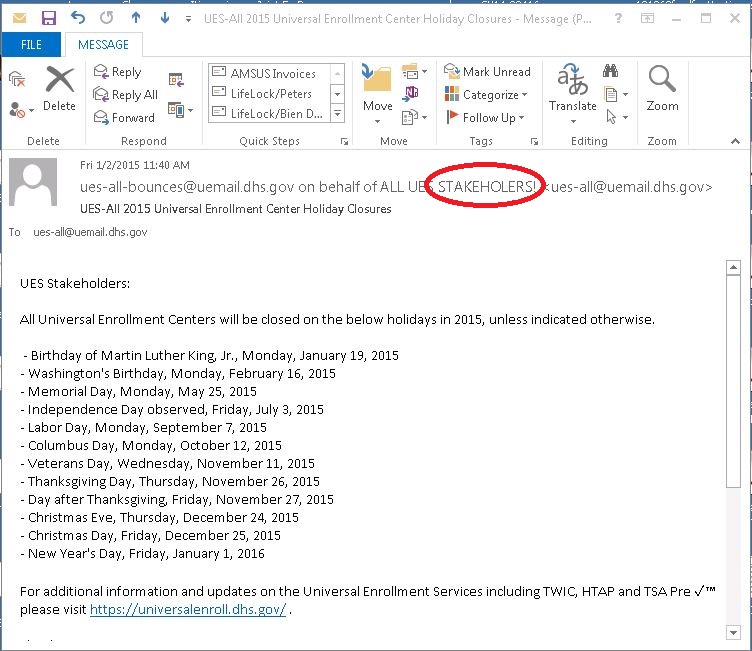
I received this email and noticed the error in the address line. It is correct in the body of the email, so obviously someone knew the right way to spell it or perhaps they were just taking a 50/50 chance knowing that one of them would be right and hoping no one would notice.
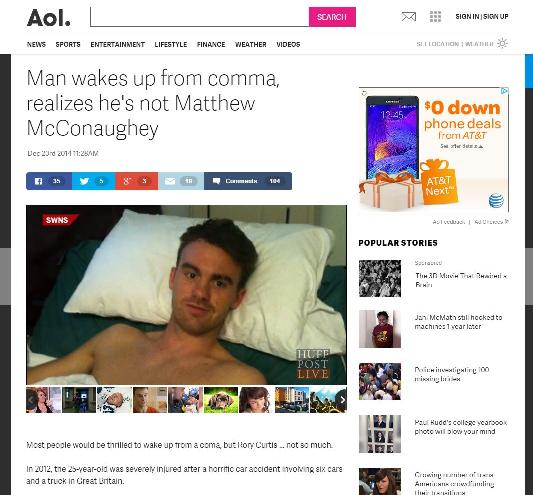
This was on a friend’s Facebook page. Even though it is only one letter, there is a huge difference between “comma” and “coma.” Let the punctuation jokes begin.
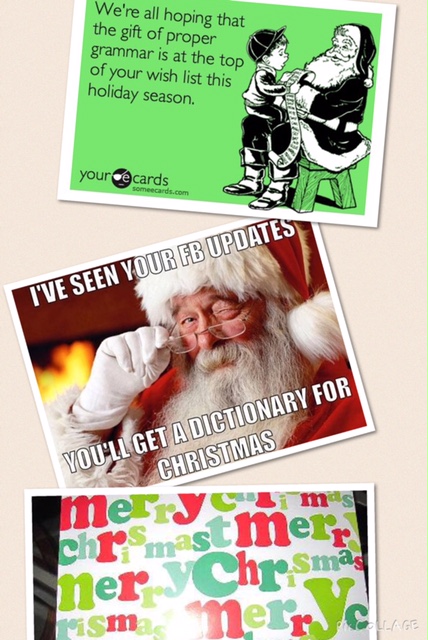
Wishing a very Merry Christmas to those of you who celebrate and as your gift I include a collage of some memes on the theme and a gift wrap with a slight problem, but there is a “t” in there somewhere!
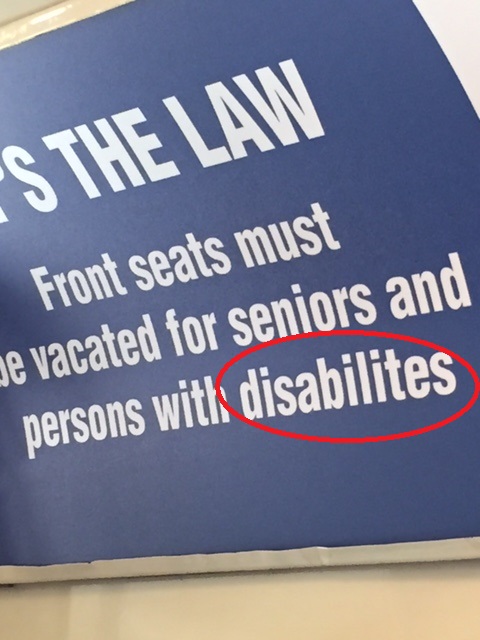
On a trip to San Francisco this past weekend, I had the opportunity to ride the bus. I love to read the signs on buses because I find a lot of “material” there. I was lucky this time as well. It took me a minute or two because I looked at the sign and finally figured out why it looked weird to me–“disabilities” is misspelled. On the plus side, they are consistent. I rode more than one bus that had the same sign with the same error. Shame on you #SFMTA!
 Follow