
Thank goodness for housebroken panini makers . . . and the entertainment provided by leaving letters off of words.


Thank goodness for housebroken panini makers . . . and the entertainment provided by leaving letters off of words.
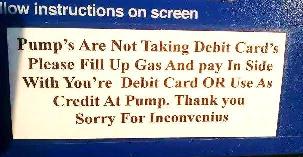
There are so many errors in this one sign I don’t think I could even get through them all. There are apostrophes used to make words plural, not enough periods, words that should be a single word divided into two words, capital letters where there doesn’t need to be or a small letter (if you want to be consistent) where a capital letter should be, misspellings . . . and my brain has now exploded.
We all know that of all the writing you do, one of the most important is your résumé. It is a potential employer’s first impression of you and if there are errors, that isn’t a very good impression. I found this article at http://www.resumark.com/blog/andrew/top-15-of-the-most-hilarious-spelling-mistakes-on-resumes-and-cover-letters/ with some interesting résumé and cover letter errors.

Copyright: iqoncept / 123RF Stock Photo
20. “I have a known track record and excellent experience with accurancy and fixing erors”
19. “Strong Work Ethic, Attention to Detail, Team Player, Attention to Detail”
18. “My experience include filing, billing, printing and coping”
17. “Demonstrated ability in multi-tasting.”
16. “My work ethics are impeachable.”
15. “I have nervous of steel.”
14. “I consistently tanked as top sales producer for new accounts.”
13. “I am a perfectionist and rarely if if ever forget details.”
12. “Dear Sir or Madman,”
11. “I can type without looking at thekeyboard.”
10. “Instrumental in ruining entire operation for a Midwest chain store.”
9. “I am anxious to use my exiting skills”
8. “Speak English and Spinach”
7. “I am a Notary Republic”
6. “I attended collage courses for minor public relations”
5. “Following is a grief overview of my skills.”
4. “I’m attacking my resume for you to review.”
3. “I am experienced in all faucets of accounting.”
2. “Hope to hear from you, shorty.”
And the most embarrassing one to finish off our list:
1. “Directed $25 million anal shipping and receiving operations.”
While we may laugh (or, more likely, groan) about these errors, the fact that HR people took note and then passed the errors on is proof positive that people are actually reading things when they are determining whether or not to bring you in the door. Please make sure your résumé and cover letter are completely error free. Ask for help if you need it, but then remember that learning proper grammar is up to you and you should make an effort to continue to learn as the rules continue to change. It is easier than ever in this technology age to follow a blog or two or take an online course to keep your skills sharp. Do it!
 Here are some rather random facts that you may or may not know:
1. Did you know that an envelope should be addressed in all caps, with street direction and designation abbreviated (i.e., 315 W CENTRAL AVE), with no punctuation, with the addressee’s name and title on the first line, the name of the company on the second line, the street address and suite number on the third line, and the city, two letter state abbreviation, and ZIP code on the last line? Postal OCR machines read from the bottom up to decide where to send the letter to be delivered, so if you use this format, your letter may just get there before one in another format. See USPS Publication 28 for detailed information about addresses.
2. Did you know that in a business letter an attention line is not really necessary? If you are directing it to someone’s attention, just address it to them. There really is no need for the “Attention” unless you do not know someone’s name and want to address it to “Human Resources Manager” or something like that. But with technology and the availability of corporate information today, you may be able to figure out who that person is and get your letter delivered directly to a person instead of to the “Occupant” trash bin.
3. Did you know that irregardless is not a word you should be using? Use regardless instead.
4. Did you know that emails should be written in English and not in “text speak”? Of course you did! I was just testing you.
5. Did you know that ellipsis marks are three spaced periods (regardless of how Word wants to format them for you)?
6. Did you know that you should proofread pleading captions and titles, inside addresses and re: lines in letters, and other things that may not be obvious to the author, but someone will be looking at so it should be right? Some attorneys have their Word settings so that the spell checker does not check words with all caps–which includes most legal document titles–and so these areas are very often overlooked by the author, even though they are one of the first places the reader will go. You certainly don’t want to start your reader off with a careless typo when they have more of your writing to read, do you?
7. Did you know that emails are correspondence too? Clients, opposing counsel, and judges are all reading our emails. It is important that we take as much care with email as we do with correspondence. Email still reflects your firm, so it should be right.
Now you hopefully know one or two new things.
Do you have questions about things you come across regularly in writing and proofreading? Send an email to proofthatblog@gmail.com and we will get it in a future issue.
This was in my Facebook feed and is such a hot mess it makes my head hurt. Here are just a few of the problems I see: (1) not all legal secretaries are female; (2) not all women have long flowing manes (and the graphic is not entirely professional or appropriate); and (3) do the finest become legal secretarIES or do they become A legal secretary. I hope no one is paying money for this …

Copyright: gmf1000i / 123RF Stock Photo
A lot of specific legal phrases are Latin phrases or at least started out Latin. Latin, italics, and punctuation are more than a little confusing so we will take a little time today to try to make those things a little bit clearer.
The Latin word id. is always italicized (including the period following the “d”). Note that id. is used to refer to the immediately preceding citation in a document but ONLY when the immediately preceding citation contains only one authority. Also, if you are using id. in a footnote, it must be used only when the immediately preceding citation is within the same footnote or in the immediately previous footnote and that footnote contains only one authority. If you are responsible for cite checking documents, keep this in mind. And if you are responsible for typing documents, keep this in mind as well—in addition to italicizing the period after id. These are important (and overlooked) details.
Spero autem quod expediens erat! (I hope this was helpful!)

Copyright: 3m3 / 123RF Stock Photo
Here are just a couple of quickies that don’t really warrant an entire blog post, but where readers have requested clarification.
1. Kitty corner or catty corner? According to Merriam-Webster Online, kitty-corner is used to describe two things that are located across from each other on opposite corners. Variants of kitty-corner are both catercorner and catty-corner. Which word you use could be determined by where you live. Those in the northeast part of the country use kitty-corner most often and those in the southeast part of the country use catty-corner. This website has a map based on a dialect survey that is interesting for this issue – http://www4.uwm.edu/FLL/linguistics/dialect/staticmaps/q_76.html. Basically, all three forms are correct, but catercorner and catty-corner are derivatives of the more popular katty-corner.
2. Onto or on to. Onto is a preposition describing the direction of something moving toward a surface. A trick that you can use is to check to see if on can replace onto.
She climbed onto her car.
In this sentence, onto is correct because “She climbed on her car” makes sense. On the other hand, if you left someone something in your will, you would not say “I passed my grandfather’s pocket watch on him,” so that sentence should be:
I passed my grandfather’s pocket watch on to him.
Let me know if you have something you struggle with. Chances are that it isn’t just you and others can benefit from a blog post about that very topic. Comment below or email proofthatblog@gmail.com.
 I learned something interesting this week. As much as you think you know about something, every once in a while it is good to check your resources. While I covered this topic according to the Gregg Reference Manual in a post entitled Things Are Coming to a Head(ing) about exceptions to the “capitalize everything except articles, conjunctions, and prepositions shorter than four letters” rule, a recent search through The Bluebook showed me that that rule was not correct for headings in a legal document done in “Bluebook style.” According to Section 8 of The Bluebook, in headings and titles, the first word in the heading or title and the word immediately following a colon in a heading or title should be capitalized. However, do not capitalize articles, conjunctions, and prepositions of four or fewer letters unless they fit the criteria in the immediately preceding sentence (they are the first word of the title or immediately follow a colon).
The Bluebook does, however, refer you to The Chicago Manual of Style or the Government Printing Office Style Manual if there are questions not answered in The Bluebook about specific capitalization issues. Here are the rules on capitalization according to The Bluebook:
I guess I’ll have to read through The Bluebook again just for good measure to see what other “rules” need to be adjusted.
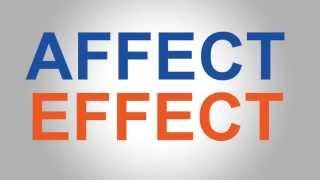 I had a request to write about affect and effect. Since I’ve had trouble with those words in the past myself, I completely understand how confusing they are! Dictonary.com defines affect as a verb (used with an object) meaning:
“Cold weather affected the crops.“
“The music affected him deeply.“
“to affect knowledge of the situation.“
“to affect a Southern accent.”
It is also defined as a noun meaning feeling or emotion.
Effect is defined as a noun:
“Exposure to the sun had the effect of toughening his skin.“
“His protest had no effect.“
And as a verb (used with object):
“The new machines finally effected the transition to computerized accounting last spring.“
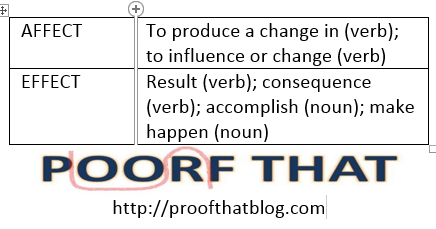
So what does that mean really? Affect is usually used as a verb to mean to influence or change. Effect is either used as a verb meaning to bring about or as a noun meaning the result or impression. Which would you choose when you hear “The wine didn’t have quite the affect/effect she was hoping for”? Some of these are so close that either could be correct, so you need to dig just a little bit deeper. First, you need to decide if it is a verb (an action word) or a noun (the name of a person, place, object, idea, quality, or activity). “The wine didn’t have quite the [action] she was hoping for.” So the verb definitions are affect to influence or change and effect to bring about. Would you say “The wine didn’t have quite the influence or change she was hoping for” or “The wine didn’t have quite the bring about she was hoping for.” The correct word is affect.
“The new paralegal was affecting/effecting the morale in the office.” The paralegal was creating an action on the morale in the office so was the new paralegal influencing or changing (affecting) the morale or was he bringing about (effecting) the morale? It should be affecting.
“The uncertainty in the legal market affected/effected attendance at the conference.” The uncertainty influenced or changed the attendance or the uncertainty brought about the attendance? Here, it would be affected.
One more for good measure: “The ruling in this case will affect/effect future door-to-door sales.” Will the ruling influence or change sales or will the ruling bring about sales? This should be affect.
We’ve done some practice with affect/effect as verbs, let’s try one as a noun. “The affect/effect of the storm damage won’t be known for some time.” Is it the feeling or emotion of the storm damage that won’t be known or is it the result of the storm damage that won’t be known? It should be effect.
These two words are very confusing. If it will help, copy the chart below and keep it at your desk for a quick reference:
 There is some confusion over whether to use a singular or a plural verb when using the famous connectors or, either . . . or, neither . . . nor, or not only . . . but also. Here is a quick rundown that should help.
If you are connecting singular words using or, either . . . or, neither . . . nor, or not only . . . but also, the subject is singular, so you would use a singular verb.
Note that it is now also acceptable to connect more than two words using the connectors above.
If you are connecting two or more plural words using or, either . . . or, neither . . . nor, or not only . . . but also, the subject is plural, so you would use a plural verb.
When you are using a mix of singular and plural words connected with or, either . . . or, neither . . . nor, or not only . . . but also, the verb should agree with the nearer part of the subject.
I hope this helps. Do you have a topic that continues to confuse you? Either leave a comment below or email me at proofthatblog@gmail.com and watch for a future blog post trying to make that topic easier to understand.
 Follow