
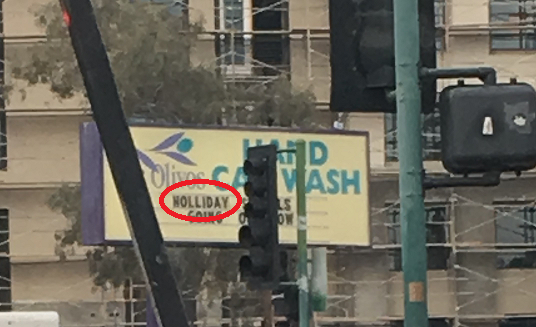
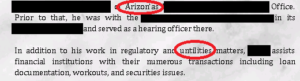
I’m hoping this is his last name and not the grammar disaster it appears to be.


Check out the updated article at ENCORE – The State of Capitalizing State
I need to clarify something in a blog post published in 2014 on Capitalization in Legal Documents. The capitalization of the word “state” is obviously very confusing depending on your preferred resource.
According to the Gregg Reference Manual, “state” should be capitalized:
Most other sources I’ve found disagree with Gregg’s first example and say that “state” should not be capitalized when used as a proper noun but is capitalized when used in place of a particular state or referring to a specific governmental body:
According to another favorite resource of attorneys, the Chicago Manual of Style, “where the government rather than the place is meant, the words state, city, and the like are usually capitalized.”
Another resource simplifies it as when you are using “state” as a common noun, you would not capitalize it:
But do capitalize “state” if it is part of a proper name
All resources agree that “state” should be capitalized when it is a party to litigation.
The only comfort in all this confusion is that obviously everyone is confused. In fact, in many recent U.S. Supreme Court cases, “state” is capitalized in different instances, which may be a holdover from style from the 18th Century when many common nouns are capitalized.
I have seen this sign every day for several weeks at a local car wash but had the opportunity at a stoplight to snap a quick (although nowhere near professional) picture. Yes, this sign–misspelled “holiday” and all–has been up for weeks.
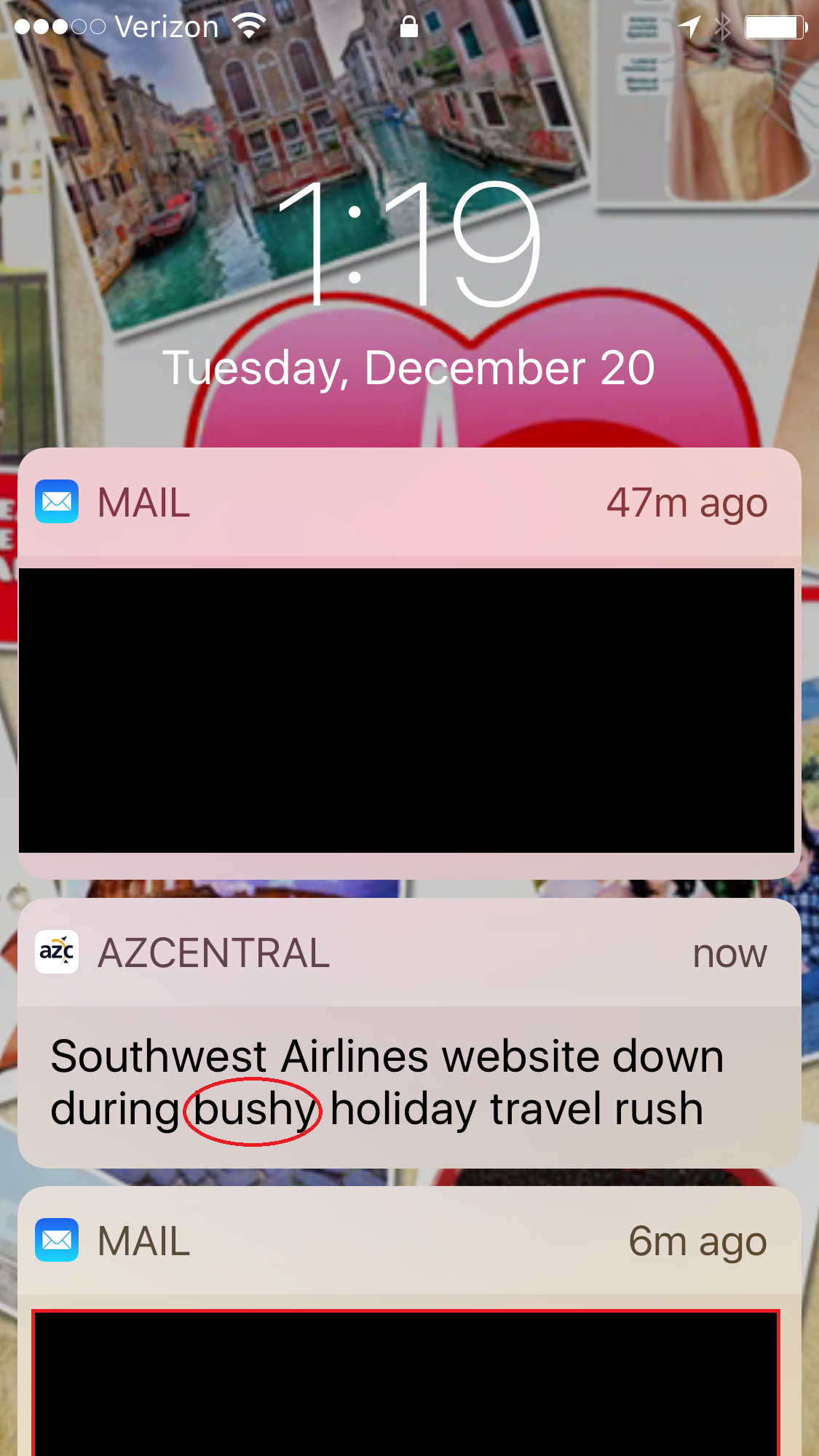
I saw this notification on my phone while traveling recently during the “bushy” holiday season.
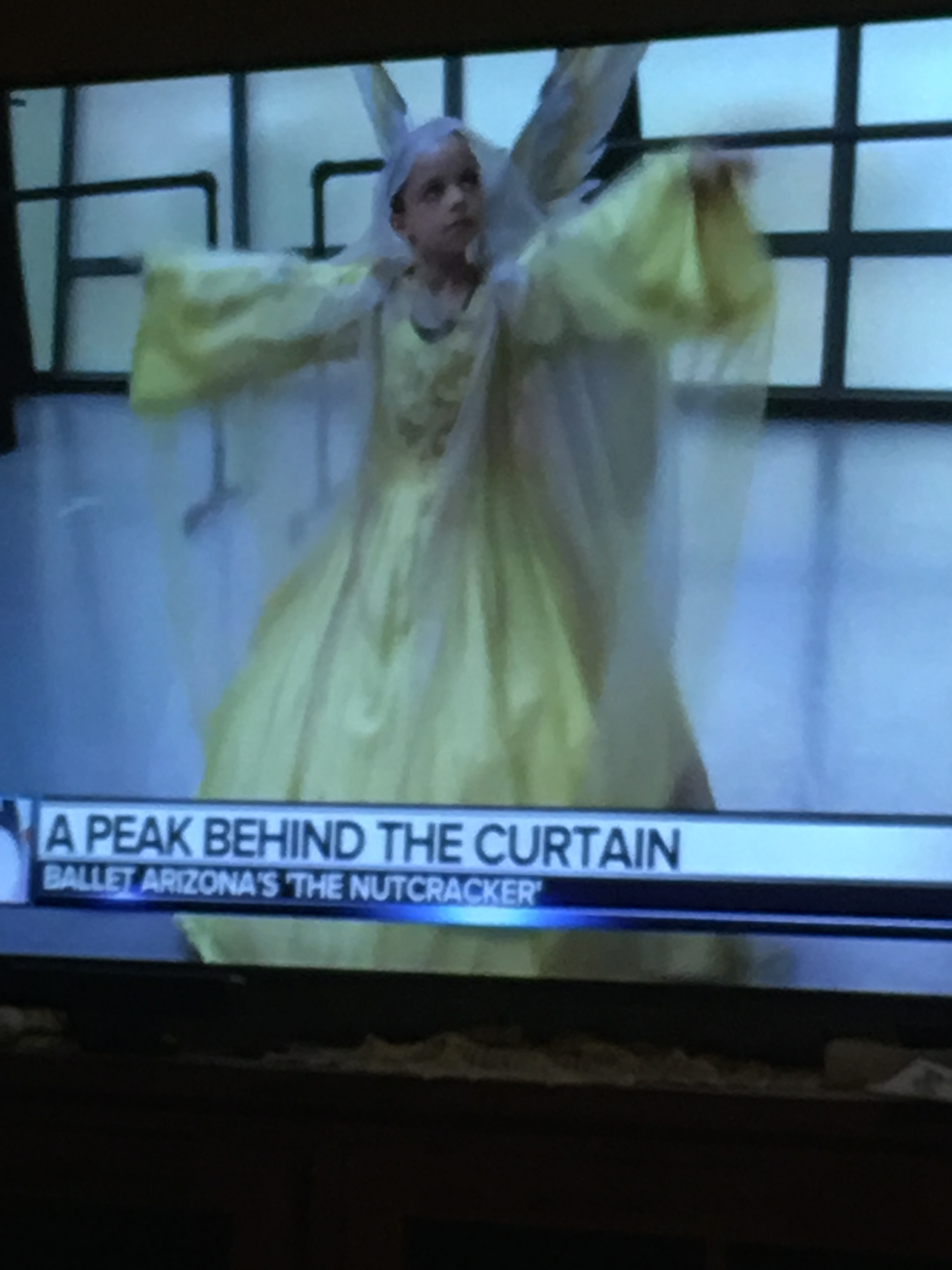
Almost exactly a year ago, I posted a similar Grammar Giggle (Take a Peak At This) from a different local news station. It must be something about the season that brings this out in news stations. Again, peak is the top, peek is to look slyly at, and pique is resentment or to offend. I’m pretty sure they mean they are looking slyly at the Nutcracker (because they are behind the curtain).
 Something that I see a lot in my daily proofreading is a comma before and. Apparently, the lessons in elementary school on serial commas or using commas in compound sentences have morphed into ALWAYS using a comma before the word and. Here are the tricks I use to help figure this out.
First, sometimes a compound sentence (which is a sentence of two independent clauses joined by a conjunction) is confused with a simple sentence with a compound predicate (the part of the sentence telling what the subject does or what is done to the subject or the subject’s state of being).
So when you have a sentence that reads:
Jamie was a paralegal and she was highly skilled in trial graphics.
you should read on each side of the and so you will read:
Jamie was a paralegal.
She was highly skilled in trial graphics.
Those are two independent sentences, so a comma is needed before the and when you make it a compound sentence.
Jamie was a paralegal, and she was highly skilled in trial graphics.
Where you have a sentence with a compound predicate, such as:
Jamie was a paralegal and was highly skilled in trial graphics.
there is no comma. You can’t say:
Jamie was a paralegal.
Was highly skilled in trial graphics.
so it is not two independent clauses.
When you are confused about whether they are independent clauses or not, read each part on either side of the and as if it were a separate sentence. If it is a complete sentence, then put the comma before the and. If the two clauses do not make sense as an independent sentence, then there is no comma before the and.
Here are some more examples to help you see this concept.
He needed to go to the grocery store, and he was going to meet James for lunch.
COMPOUND?
He needed to go to the grocery store.
He was going to meet James for lunch.
YES – NEEDS A COMMA.
He needed to go to the grocery store and was going to meet James for lunch.
COMPOUND?
He needed to go to the grocery store.
Was going to meet James for lunch.
NO – NO COMMA NEEDED.
The corporation filed its annual report with the Corporation Commission, and it paid the required fee.
COMPOUND?
The corporation filed its annual report with the Corporation Commission.
It paid the required fee.
YES – NEEDS A COMMA.
The corporation filed its annual report with the Corporation Commission and paid the required fee.
COMPOUND?
The corporation filed its annual report with the Corporation Commission.
Paid the required fee.
NO – NO COMMA NEEDED.
I hope this helps with some of the constant “comma drama” that you may find yourself in daily. Email proofthatblog@gmail.com if you have any other “drama” that you would like to see as a topic of a future Proof That proofreading blog post.
I had to research the partner of the person from the Firm Bio Grammar Giggle earlier this week and you’ll never believe it, but this bio was worse! Not only are there numerous misspellings, but the bar association in Arizona is called the State Bar of Arizona NOT the Arizona State Bar Association. Those details are really important. This could very well be the first impression people get of you, make sure it is a good one.
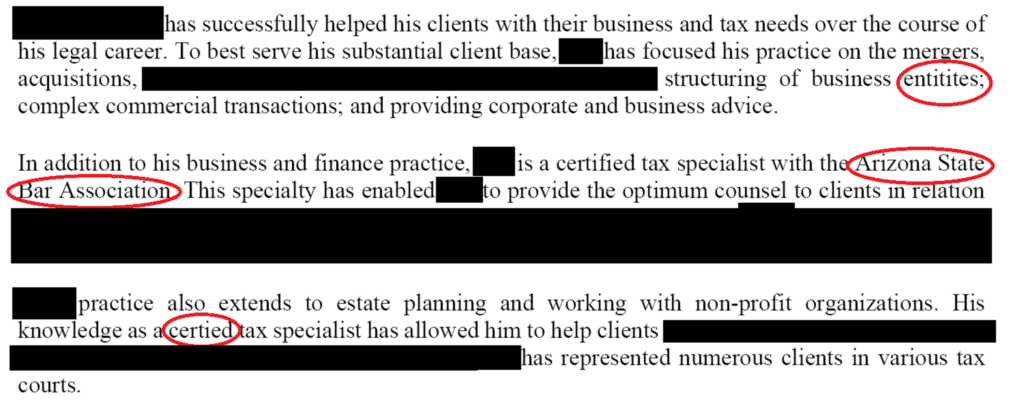
I actually found this while researching a potential witness. Your online bio is really important and should be error free. This is my first impression of this professional and I must admit, it’s not a very good one.
 A couple of years ago, I posted an article about Thanksgiving and other holidays and grammar issues. Since it is time again, here is an encore of that article.
Thinking about Thanksgiving here in the United States got me thinking about names of holidays and grammar rules. For instance, if you use Eve or Day with the name of a holiday, i.e., Thanksgiving Day, you capitalize day. However, if you were to say “the day before Thanksgiving,” day would not be capitalized. Religious holidays are also capitalized
Even some “invented” holidays are capitalized
Is happy capitalized when used with a holiday? If you exclaim “Happy Thanksgiving!” then it is, but if you use it in a regular sentence “I wish you all a happy Thanksgiving,” then it is not.
Generally, the seasons of the year are not capitalized unless it is part of a proper name.
When using seasons to describe time of year, remember that seasons are reversed in the Northern and Southern Hemispheres. When it is summer in the U.S., it is winter in most of South America and Australia. In that case, it is clearer to say “the first three months of the year,” or “the last quarter of 2014.”
As for possessives with the word “season,” the phrase Season’s greetings! is possessive because you are referring to holidays that happen only during one season—winter. Possessives with names of holidays are usually singular; however, where the holiday is plural, the apostrophe is after the plural word:
The official holiday name wins out over plurals and possessives, so you may just have to look it up to be positive you are correct.
I wish you all a happy Thanksgiving and know that when I count my blessings, the people who read my blog faithfully, those who stumble across it, and those who cheer me on are near the top of my list. Thank you!
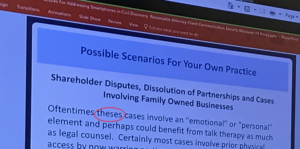
A friend sent this to me. I actually missed the error the first couple of times I read through it quickly, but it is there. I also looked up “Oftentimes,” which, while correct, is archaic and could easily be replaced with “Often.” Our goal should always be to make our writing more readable.
 Follow